Last Man Standing by Duff Mcdonald
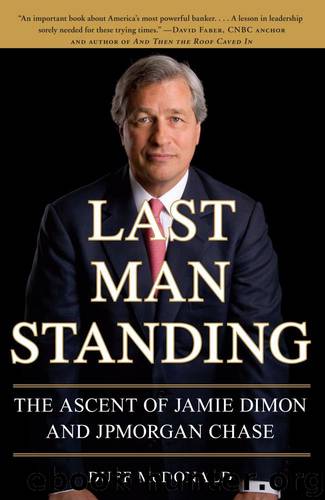
Author:Duff Mcdonald
Language: eng
Format: epub
Publisher: Simon & Schuster Book For Young Readers
Published: 2008-12-31T16:00:00+00:00
11. WINNING BY NOT LOSING
Friendly foreign ministers notwithstanding, Dimon inherited a company that had been losing its world-class cachet for decades. The merger with Chase Manhattan had done nothing to resuscitate it; in fact, it had the opposite effect. In The House of Morgan, the financial historian Ron Chernow writes that executives at J.P. Morgan had rejected entreaties from Chase as far back as 1953, out of fear that a merger would endanger the firm’s reputation for “haute banking.” Those fears proved valid.
This is not to say that Chase Manhattan had no pedigree of its own. Its earliest predecessor company actually predates J.P. Morgan & Company itself by nearly a century. After Alexander Hamilton founded the Bank of New York, the nascent state’s first commercial bank in 1784, he had the playing field to himself until 1799, when his political rival Aaron Burr founded the Bank of Manhattan. That bank’s predecessor, the Manhattan Company, had been one of the island’s first water companies; it used hollowed-out pine logs as its pipes. Burr took advantage of a legal loophole that allowed the company to invest its excess capital outside its primary business, and in the process founded the bank. Hamilton and Burr eventually settled their differences in a duel, and JPMorgan Chase owns the pistols they used. They’re displayed on the fiftieth floor of the Park Avenue headquarters and are worth an estimated $25 million.
A banker named John Thompson founded the Chase National Bank in 1877. He named his firm after Salmon P. Chase, who’d been President Lincoln’s secretary of the treasury as well as chief justice of the United States. Chase came to be called “the Rockefeller bank” because of its extensive ties to industrialist John D. Rockefeller. His grandson David joined the firm in 1946 and eventually took over as CEO. In 1955, after being spurned by J.P. Morgan, he and the chairman, John J. McCloy, merged Chase with the Bank of Manhattan, creating Chase Manhattan. In 1960, Rockefeller oversaw the construction of the bank’s downtown headquarters at One Chase Manhattan Plaza (technically, Liberty Street). At the time, it had the largest bank vault in the world.
Chemical Bank swallowed Chase Manhattan in 1996. Chemical had been on an acquisition tear of its own under the leadership of Walter V. Shipley, purchasing Texas Commerce Bank in 1986 and Manufacturer’s Hanover in 1991. (As with Chase, its roots predate that of J.P. Morgan & Company; it was founded in 1823 as a producer of chemicals including camphor and saltpeter.) Bob Lipp later served as a historical bridge between the Commercial Credit crowd and those he’d worked with at Chemical in the 1980s.
J.P. Morgan & Company had its roots in the “gilded age” of American finance. Founded in 1871 by J. Pierpont Morgan and the Philadelphia banker Anthony Drexel, the bank dominated the country’s burgeoning railroad industry, and soon became the most influential and powerful bank to corporate interests in the country. It went on to save the U.S. Treasury with an
Download
This site does not store any files on its server. We only index and link to content provided by other sites. Please contact the content providers to delete copyright contents if any and email us, we'll remove relevant links or contents immediately.
Hit Refresh by Satya Nadella(9116)
When Breath Becomes Air by Paul Kalanithi(8418)
The Girl Without a Voice by Casey Watson(7877)
A Court of Wings and Ruin by Sarah J. Maas(7807)
Do No Harm Stories of Life, Death and Brain Surgery by Henry Marsh(6931)
Shoe Dog by Phil Knight(5252)
The Rules Do Not Apply by Ariel Levy(4953)
A Higher Loyalty: Truth, Lies, and Leadership by James Comey(4946)
Hunger by Roxane Gay(4920)
Tuesdays with Morrie by Mitch Albom(4763)
Everything Happens for a Reason by Kate Bowler(4729)
The Immortal Life of Henrietta Lacks by Rebecca Skloot(4571)
Millionaire: The Philanderer, Gambler, and Duelist Who Invented Modern Finance by Janet Gleeson(4457)
How to Change Your Mind by Michael Pollan(4350)
All Creatures Great and Small by James Herriot(4303)
The Money Culture by Michael Lewis(4186)
Man and His Symbols by Carl Gustav Jung(4120)
Elon Musk by Ashlee Vance(4118)
Tokyo Vice: An American Reporter on the Police Beat in Japan by Jake Adelstein(3973)
